THE CUREMANI EDIT / BUYING GUIDE
Square vs Coffin vs Almond Press-On Nails
Choose the outline that belongs in your routine.
As an Amazon Associate I earn from qualifying purchases. Some links below are affiliate links; official brand links are labeled separately. About our links.
Editorial research review · Sources checked October 16, 2026 · No hands-on wear test or independent performance score.
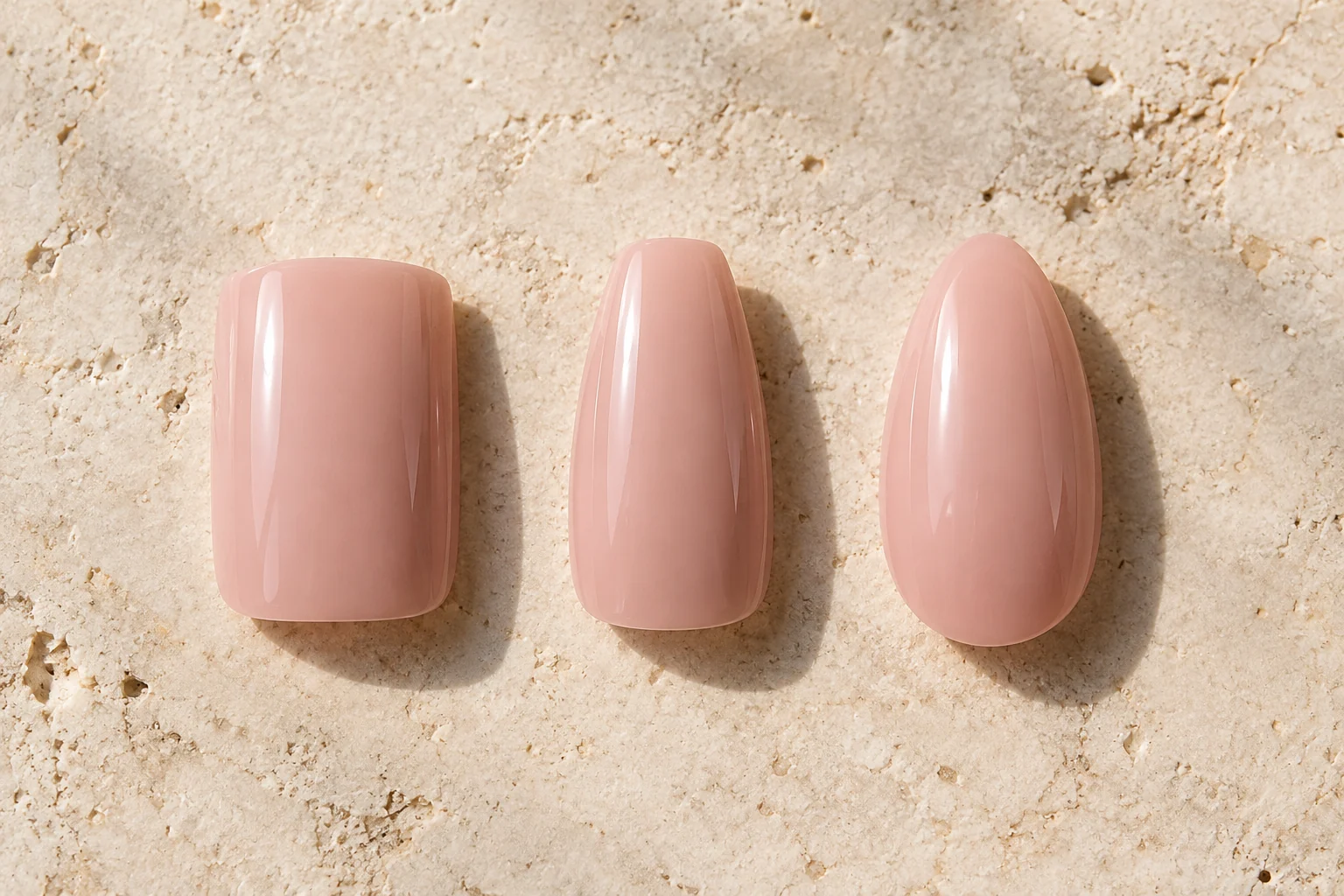
Square, coffin, and almond press-on nails can create very different impressions even when they share the same color. Before choosing a brand, it helps to decide what you want the outline to do. Are you looking for a straight, graphic edge, a tapered shape with a flat end, or a softer curve toward the tip?
This is an editorial comparison based on shape characteristics and documented product specifications, not a laboratory or hands-on ranking. We have not established that one shape lasts longer, breaks less often, or suits every nail bed. The aim is to make the shopping decision more specific and reduce the chance of buying a beautiful set in the wrong format.
| Shape | Visual cue | What to check |
|---|---|---|
| Square | A straight free edge | Width and corner proportions |
| Coffin | Taper toward a flat end | Where the taper begins |
| Almond | Taper toward a rounded tip | Curve and actual length |
| All three | Names vary between ranges | Fit of the portion resting on your natural nail |
In this guide · 13 sections
- Three outlines, three different visual starting points
- Start with the amount of extension
- Square: when a straight edge is the point
- Coffin: taper without a pointed finish
- Almond: a continuous curve toward the tip
- Nail-bed fit is separate from the decorative outline
- Finish can change how a shape reads
- Work, hobbies, and daily objects
- Occasion styling without overbuying
- What photographs cannot tell you
- Buying one useful set instead of three uncertain ones
- Our shape-selection checklist
- Products that illustrate the differences
Three outlines, three different visual starting points
A square nail has a relatively straight free edge and sides that do not strongly taper toward a point. A coffin shape narrows toward a flat tip. An almond shape narrows toward a rounded tip rather than ending in a straight line. Retailer naming is not perfectly standardized, so photographs and measurements still matter.
Our styling interpretation is that square feels more architectural, coffin combines structure with taper, and almond emphasizes a softer continuous curve. Those descriptions are useful visual shorthand, not personality categories. You can wear square nails with a romantic dress or almond nails with a sharply tailored suit.
Avoid treating the shapes as a hierarchy of elegance. A well-chosen short square can be just as intentional as a long almond. Your preferred proportion, finish, and degree of contrast matter more than following a claim that one outline is universally more flattering. The product should support your taste rather than correct an imagined flaw in your hands.
Start with the amount of extension
The same outline can look and feel different at different lengths. A modest square edge may create a neat everyday shape, while a much longer version becomes a visible design feature. An almond outline may be gently rounded in a short set and noticeably tapered in a longer one.
Think about the distance beyond your fingertip that you are willing to accommodate. Product labels such as short, medium, and long are relative to each brand and range. If a listing provides dimensions, use them. If it does not, avoid assuming that a medium from one company matches a medium from another.
A useful shopping method is to write down the tasks you perform most often and the longest style you already know feels manageable. That gives you a practical reference point. You can still choose something more dramatic for an occasion, but the decision becomes intentional instead of being driven solely by the most attractive product photograph.
Square: when a straight edge is the point
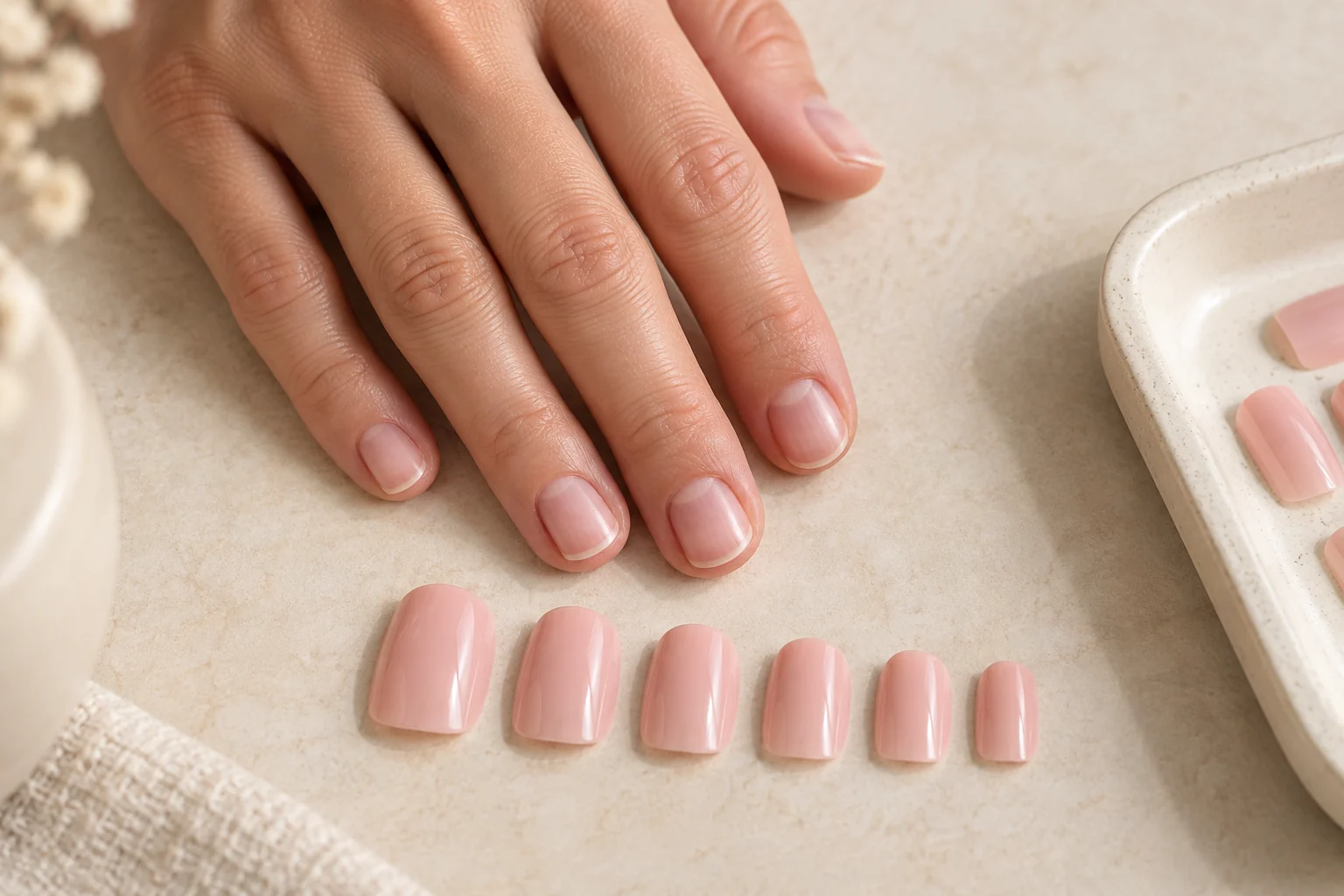
Square is worth considering when you like a defined tip, geometric nail art, or a French design with an obvious horizontal finish. In our view, the shape works especially well when you want the edge itself to be part of the look. A simple solid color can also let the outline stand on its own.
The area to evaluate carefully is the combination of width and length. A broad, long square may look more substantial than you expected from a close-up image. That does not make it unsuitable, but it is a reason to compare whole-hand photographs rather than choosing from a single isolated nail.
Check the corners during your fit and practicality assessment. How they interact with your routine will depend on the actual product and your movements. We do not assume that all square nails catch or that all rounded alternatives avoid catching. Those are use observations that need to be made for the specific set you choose.
Coffin: taper without a pointed finish
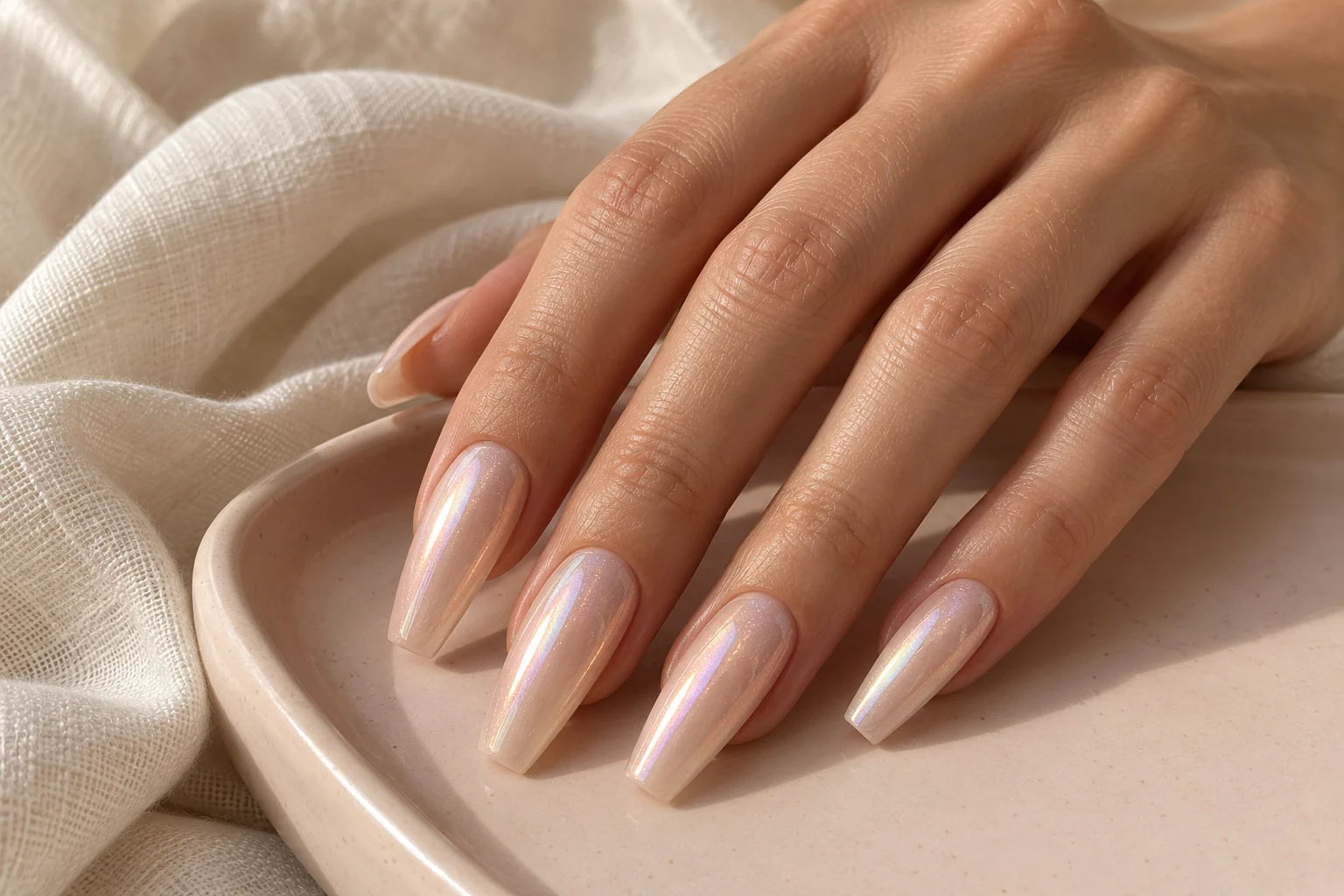
Coffin is an option for someone who wants visible narrowing while retaining a straight end. It can provide a long visual line without the fully rounded tip of an almond. With a pale or reflective finish, the silhouette may become the most noticeable part of the manicure.
Look closely at how early the taper begins. Two products labeled coffin can have different proportions: one may narrow gradually, while another remains broader until closer to the tip. Their appearance on your hands can therefore differ even if the retailer gives them the same length label.
Do not purchase a coffin set solely because you expect it to make your fingers look a particular way. Promotional hand poses and camera angles can exaggerate proportions. A better question is whether you enjoy the outline when the hand is relaxed, holding a familiar object, or resting naturally. That is closer to how you will see the manicure throughout the day.
Almond: a continuous curve toward the tip
Almond is a useful direction if you prefer a rounded, tapered finish. It can work with solid colors, small French accents, and softer patterns. Our aesthetic preference for this outline is strongest when the curve looks balanced across the whole hand rather than becoming sharply pointed on one finger and broad on another.
The word almond does not establish the length. There are short almond sets as well as longer options, and the difference is important. If you are seeking a dramatic extension, confirm that the example you are viewing actually provides it. If your priority is a smaller change from natural nails, a short version may be more relevant.
Also distinguish almond from stiletto or oval where the listing does so. Retail photographs can blur the categories, particularly at small sizes. Read the selected option and inspect the tips. A familiar shape name is useful only when it corresponds to the physical product that arrives.
Nail-bed fit is separate from the decorative outline
The shape you see beyond the fingertip is only part of a press-on. The portion that rests on your nail must also suit its width, curve, and cuticle area. Choosing an almond tip does not automatically solve a curved or flat nail-bed fit issue.
This distinction helps explain why a flattering photograph is not enough. A product can have exactly the free-edge silhouette you want and still fail to sit comfortably. Conversely, a set with a less exciting color may provide useful information about which construction and size range work for you.
During dry sizing, compare contact and comfort rather than forcing a piece into place. Follow the package guidance for selecting sizes. If a suitable match is unavailable, try another set instead of treating excess adhesive as a universal solution. Brand size numbers are not transferable measurements, so keep notes alongside the product name rather than recording numbers alone.
Finish can change how a shape reads
A strong French tip gives the eye a boundary that emphasizes the free edge. An all-over dark color can make the entire outline easy to see. A translucent-looking or pearly finish may shift attention toward light and texture. These are styling observations, not statements about how the products perform.
For a fair visual comparison, try to keep color and length similar. Comparing a long black square with a short pale almond changes three variables at once. If you prefer the second photograph, you may be responding to the color or length rather than the shape.
When exact comparisons are unavailable, say what attracts you specifically. You might like the narrow tip, the subtle color, or the absence of a contrasting line. That description becomes a useful search brief. It is more actionable than deciding that a particular brand always looks better on everyone.
Work, hobbies, and daily objects
Make a short list of tasks that your manicure must coexist with. Typing is one example, but also consider fastening jewelry, using kitchen tools, caring for someone, working with gloves, or practicing an instrument. Workplace rules may determine your options before style preferences enter the decision.
The purpose of this list is to identify constraints, not to prove that long nails are impractical. Some people have established ways of adapting their movements, while others prefer not to. Your comfort with those adjustments matters more than a social-media demonstration of what another person can do.
If you are trying a longer shape for the first time, choose a period when you can evaluate it without an important task depending on immediate familiarity. You do not need to aim for maximum wear. A useful first experience might simply establish that a particular length is more than you want for regular use.
Occasion styling without overbuying
For a special occasion, begin with the clothes and accessories you already intend to wear. A defined French square could repeat a crisp detail; a pearly coffin could add reflection; a pastel almond could introduce a restrained color accent. These are possible design directions, not compulsory combinations.
Choose one main effect. If the shape is dramatic, a simple color may be enough. If the design is detailed, a more familiar length may help you focus on the decoration. You can combine multiple effects, but doing so intentionally is different from buying every appealing feature in one set.
Order with enough time to inspect and size the nails. Keep a fallback that does not depend on a last-minute delivery. The benefit of advance planning is that you can reject a mismatch without feeling that you have spoiled the entire outfit. A manicure is one part of the occasion, not an obligation to tolerate a poor fit.
What photographs cannot tell you
Images can show outline, color direction, and styling possibilities. They cannot reliably tell you comfort, adhesive strength, exact thickness, or how a set will sit on your nail bed. Even an unedited customer image represents one person’s hands and application choices.
Look for relaxed poses, side views, and a variety of fingers. A hand with only the four fingers curled inward may conceal the thumbnail fit. A highly angled shot may make a long shape appear narrower. These limitations do not make photographs useless; they simply define what kind of information the photograph can provide.
Avoid using generated inspiration images as evidence of a product’s actual dimensions or performance. On CureMani, an illustrated style preview is a way to imagine a color story, not proof of an observed result. For product identification, use the listing, package details, and manufacturer specifications together.
Buying one useful set instead of three uncertain ones
Start with the shape you are most likely to wear and a clearly identified product. Compare its selected length, contents, and application method. A low price per piece is less useful than a complete set of sizes that can fit both hands.
If you are choosing between two shapes, make the distinction explicit. For example, one might provide the French tip you want while the other offers the shorter length you need. That is a real tradeoff. An advertisement describing both as elegant or comfortable does not resolve it.
After a satisfactory first purchase, you can explore another shape using what you learned about fit and length. This creates a more informative comparison than ordering several unrelated sets at once. You also avoid committing to multiple packs before knowing whether a particular brand’s size distribution is useful for you.
Our shape-selection checklist
First, establish your preferred extension length and any work restrictions. Second, choose the outline you enjoy looking at. Third, verify that a specific product offers that combination. Fourth, check sizing, application, and removal requirements. Finally, compare the total purchase with alternatives that meet the same brief.
Give greater weight to a failed fit check than to a positive style impression. A beautiful outline is not enough if the piece cannot sit comfortably. Likewise, do not dismiss a shape based on one unsuitable set; another product may use a different curve or proportion.
If you want color without selecting a full-cover extension, read our guide to semi-cured gel strips. For ready-made options, use the CureMani Shop as a shortlist and confirm the exact variant at the retailer. Our recommendations below illustrate distinct directions rather than a universal first, second, and third place.
Products that illustrate the differences
Square: KISS Core French Every Minute
The manufacturer identifies this set as a long square French design. Consider it when you want a strong straight edge and a recognizable white tip. It is a useful example of the structured direction discussed above, provided the supplied sizes suit you. Check Every Minute on Amazon
Coffin: OPI xPRESS/ON Throw Me a Kiss
The official Long Coffin version pairs taper with a pale iridescent finish. Consider it if the outline and reflection are the features you want to emphasize. It is not a short-nail alternative merely because the shade is subtle. Check Throw Me a Kiss on Amazon
Almond: Glamnetic French Lilac
This short almond design combines a neutral-looking base with pastel purple tips. It is a useful shorter reference for the rounded, tapered direction. Because its length differs from the two examples above, do not use it to infer that almond shapes as a category are more comfortable or practical. Shop French Lilac on Amazon
Product specifications can change. Confirm the selected variant and current manufacturer instructions before purchase. Source links are included beside the relevant claims.
1 thought on “Square vs Coffin vs Almond Press-On Nails”
Comments are closed.