THE CUREMANI EDIT / BUYING GUIDE
Press-On Nails vs Semi-Cured Gel Strips: Buying Guide
Added length or color at your natural edge? Start there.
As an Amazon Associate I earn from qualifying purchases. Some links below are affiliate links; official brand links are labeled separately. About our links.
Editorial research review · Sources checked October 16, 2026 · No hands-on wear test or independent performance score.
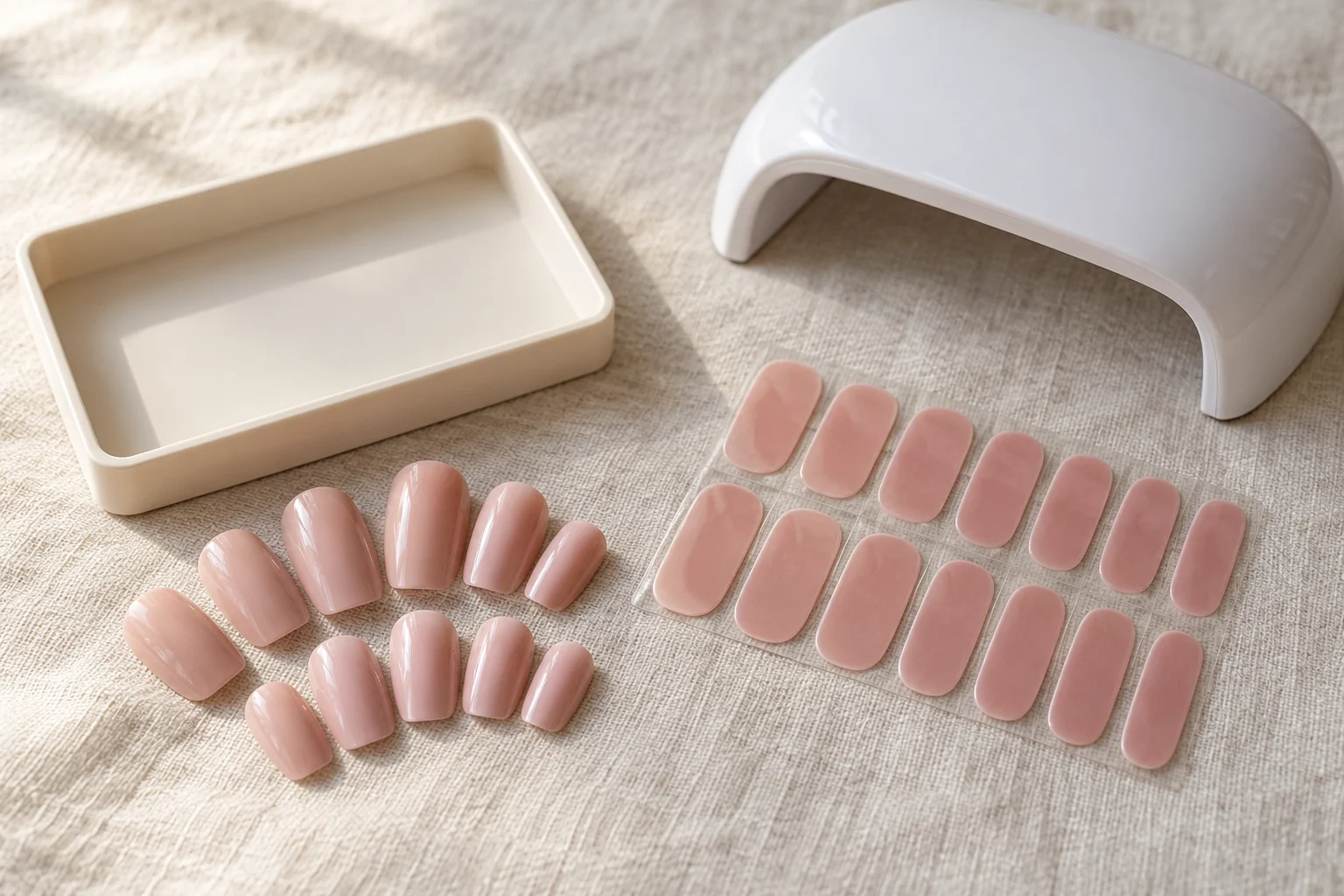
Press-on nails and semi-cured gel strips can both offer a coordinated manicure at home, but they solve different problems. A finished press-on supplies a ready-made nail shape. A semi-cured strip supplies a flexible layer of color that is fitted to your natural nail and cured according to the product’s instructions. Choosing between them becomes easier once you decide whether you want added length or mainly a different finish.
This is a research-based comparison, not a side-by-side wear test. We have not measured which category lasts longer or causes fewer problems. Both contain products with different instructions and constructions, so a category label should not be treated as a guarantee of performance.
| Question | Finished press-ons | Semi-cured strips |
|---|---|---|
| Want added length? | Choose a documented extension shape | Plan around the natural nail edge |
| Need a lamp? | Depends on attachment system; ordinary glue-on sets do not | Use the compatible curing setup |
| Main fit decision | Piece width and curvature | Strip sizing and smooth placement |
| Removal | Follow the exact attachment instructions | Follow the strip maker’s method |
In this guide · 13 sections
- What you are actually putting on the nail
- Begin with the result, then choose the process
- Fit: a rigid outline versus a fitted layer
- Equipment: compare complete routines
- Time: separate setup, application, and removal
- The visual difference in everyday use
- Durability: why there is no honest category-wide winner
- Removal: match the method to the attachment
- Nail condition and comfort belong in the decision
- Cost: the first purchase and the repeat purchase
- Four common shopping scenarios
- A practical first-purchase plan
- Products to consider by use case
What you are actually putting on the nail
A finished press-on is a shaped piece that covers the natural nail and may extend beyond it. Depending on the product, it uses a separate adhesive or arrives with adhesive already applied. The selected shape exists before you attach it, which is why the size and curve of the piece matter so much.
A semi-cured gel strip is applied as a flexible layer and then finished using the prescribed lamp-curing process. The ohora care guide illustrates the brand’s strip routine. That process should not be confused with a simple polish sticker or a ready-made plastic nail, even if the finished photographs look similar.
For the ordinary strip products discussed here, plan around your natural free edge rather than using unsupported strip material to create an extension. If you want a product specifically designed to add length, choose a system that explicitly provides that function. A photograph of long nails wearing strips does not establish that the strips created the length.
Begin with the result, then choose the process
Imagine your desired manicure without naming a brand. Perhaps it is a long square French look, a short burgundy manicure, or a pale finish on nails you have grown yourself. This description gives you a much better starting point than browsing every product labeled gel or salon quality.
If the desired shape is substantially longer than your natural nails, a finished extension is the more direct category to investigate. If the shape you want is already present, a strip may be relevant. Neither conclusion says that a particular product will fit or perform well; it simply narrows the search to the appropriate format.
This also prevents unnecessary purchases. Someone who wants color on short natural nails may not need a box of long press-ons. Someone who wants immediate length may be disappointed by a strip kit regardless of how attractive its shade is. Solve the main design requirement before comparing accessory bundles or promotional offers.
Fit: a rigid outline versus a fitted layer
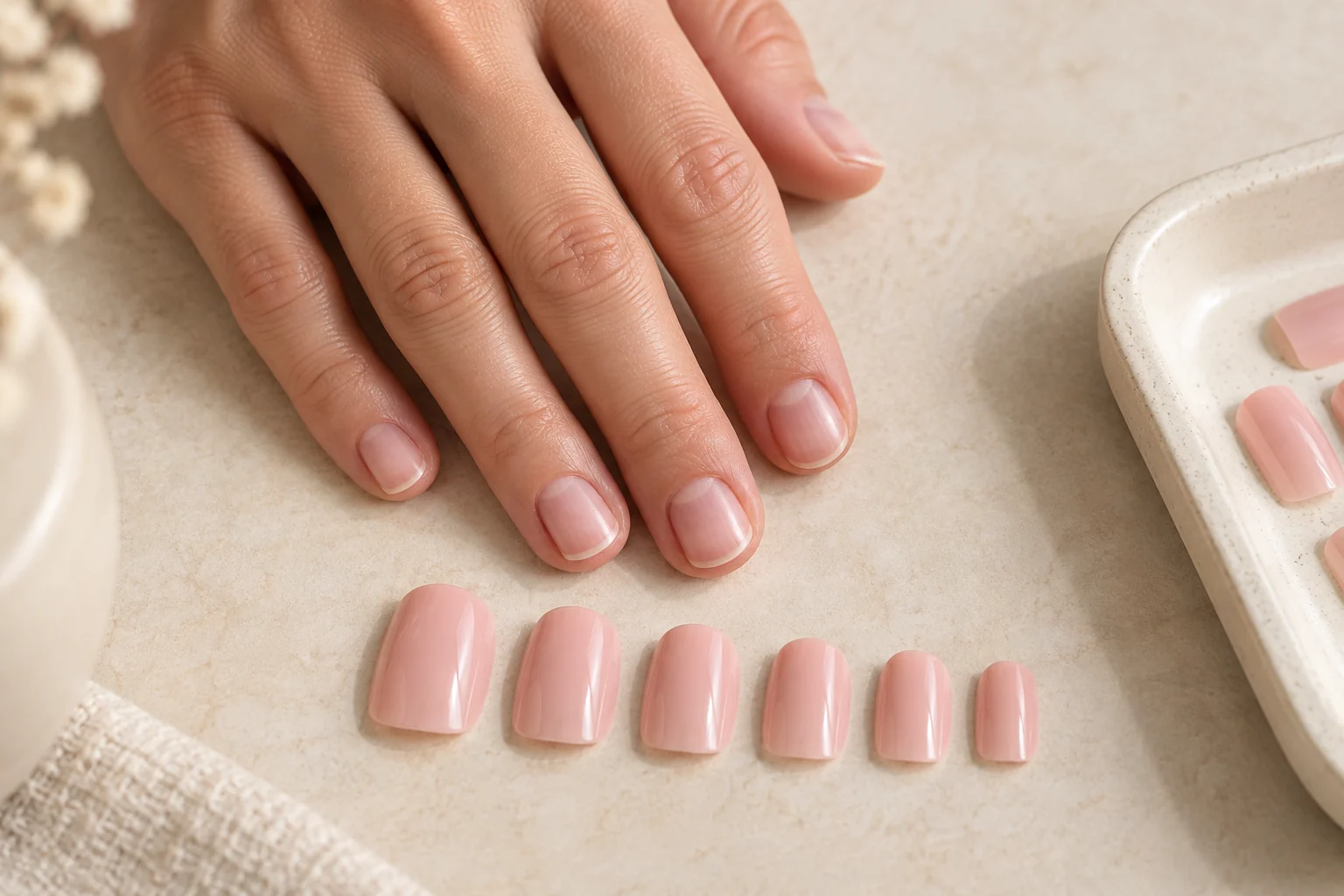
With a press-on, the challenge includes width, curvature, and the shape near the cuticle. The piece needs to sit appropriately on your nail. A size that looks right from above may still be unsuitable if its curve does not match comfortably.
With a strip, the challenge is selecting and positioning the material so it follows the nail without unwanted folds or contact beyond the intended area. The fact that the material is flexible does not eliminate sizing. It changes the type of fit problem you are trying to solve.
Avoid declaring either category easier for all beginners. Someone who finds matching rigid shapes frustrating may prefer working with strips. Someone who dislikes trimming and smoothing a flexible layer may prefer a finished piece. Your first experience can be more informative if you note which part of the process actually caused difficulty rather than judging the entire category by the final photograph.
Equipment: compare complete routines
A conventional glue-on or pre-applied-adhesive press-on does not use a curing lamp for its ordinary attachment routine. A semi-cured strip requires the compatible curing setup specified by its maker. This is one of the clearest practical differences when you are deciding what to buy.
Do not turn that distinction into a claim that every press-on system is lamp-free. Some extension systems use different attachment products. Read the actual kit instructions and identify whether you are buying a conventional finished press-on or a gel-based extension system with separate requirements.
For strips, a lamp’s appearance or advertised wattage alone is not enough to establish compatibility. Follow the product maker’s equipment guidance. Our lamp selection guide explains the purchasing questions in more detail. Buying a small inexpensive lamp without checking the system can create a mismatch rather than a saving.
Time: separate setup, application, and removal
The time shown in an advertisement may describe only the central application step. Your first attempt also includes opening the kit, reading the directions, identifying sizes, arranging tools, and deciding what to do with unused pieces. Those tasks belong in a realistic comparison.
Press-ons involve matching the pieces and attaching them according to the chosen adhesive’s instructions. Strips involve matching, positioning, shaping, and curing as directed. Which takes longer for you will depend on familiarity and the particular product. We do not assign a universal ten-minute winner.
Removal matters just as much when you plan a routine. A manicure that is quick to attach may not be quick to take off correctly. If you have only a short window before work or another commitment, consider the whole cycle rather than assuming you can remove either product instantly whenever convenient.
The visual difference in everyday use
Press-ons let you select a finished outline independently of your current natural length. This can create a visibly uniform silhouette across the hand. That is useful when a specific shape is central to the look you want, such as a long coffin or a defined square.
Strips can work with the nail shape you already have. Their visual appeal may come from color, pattern, or gloss rather than a change in extension. If you prefer a smaller departure from your usual hands, that can be an important advantage in the buying decision.
Neither category automatically looks more natural. Opacity, thickness, proportion, placement, and fit all influence the result. A short well-proportioned press-on may look restrained, while a vivid strip design may be deliberately noticeable. Use natural-looking as a description of your desired result, then identify the specific features that would create it.
Durability: why there is no honest category-wide winner
Different products, hands, routines, and application methods produce different outcomes. A single long-wear photograph cannot establish that all press-ons outperform all strips, or the reverse. Even two manicures on the same person may be difficult to compare if their activities changed.
A useful personal comparison records the starting condition, selected sizes, application method, and the first meaningful issue. Was it discomfort, a lifted edge, visible wear, or a damaged tip after a specific incident? These observations describe different problems and should not be collapsed into one unexplained rating.
Brand claims about maximum wear are not independent comparative evidence. We do not repeat them as expected results here. If wear duration is your primary concern, look for detailed current accounts of the exact products and remember that a product working well for another person does not establish that its shape or routine will suit you.
Removal: match the method to the attachment
A product that removes one type of manicure may not be appropriate for another. The important information is the adhesive or system involved, not whether the bottle is marketed with a general phrase such as nail remover. Read both the nail product directions and the removal product’s intended use.
For example, the KISS FAQ gives a specific removal approach for its glue-on nails, while ohora provides separate strip-removal guidance. Those are different routines. Do not substitute a method simply because it seemed convenient in an unrelated tutorial.
Avoid pulling attached material away in order to finish faster. If removal is not proceeding as the directions describe, stop improvising and seek product-specific help. The goal is not to preserve a set at any cost or to meet a self-imposed time limit. A successful routine includes an appropriate end to the manicure.
Nail condition and comfort belong in the decision
No cosmetic format should be described as damage-proof or universally suitable. If your nails or surrounding skin are already uncomfortable or visibly affected, adding a cosmetic covering is not a way to determine the cause. The American Academy of Dermatology advises against using artificial nails to cover nail problems.
For an otherwise straightforward purchase, comfort is still a practical criterion. A piece that presses awkwardly during sizing or a routine you cannot follow confidently is a reason to reconsider. It is not a failure to choose a simpler format or postpone the manicure.
We do not recommend one category as a treatment for thin, peeling, or damaged nails. That would require a different kind of evidence from a cosmetic product review. Keep the goal clear: choosing a decorative manicure that fits your preferences and circumstances, not diagnosing or repairing a health concern through shopping.
Cost: the first purchase and the repeat purchase
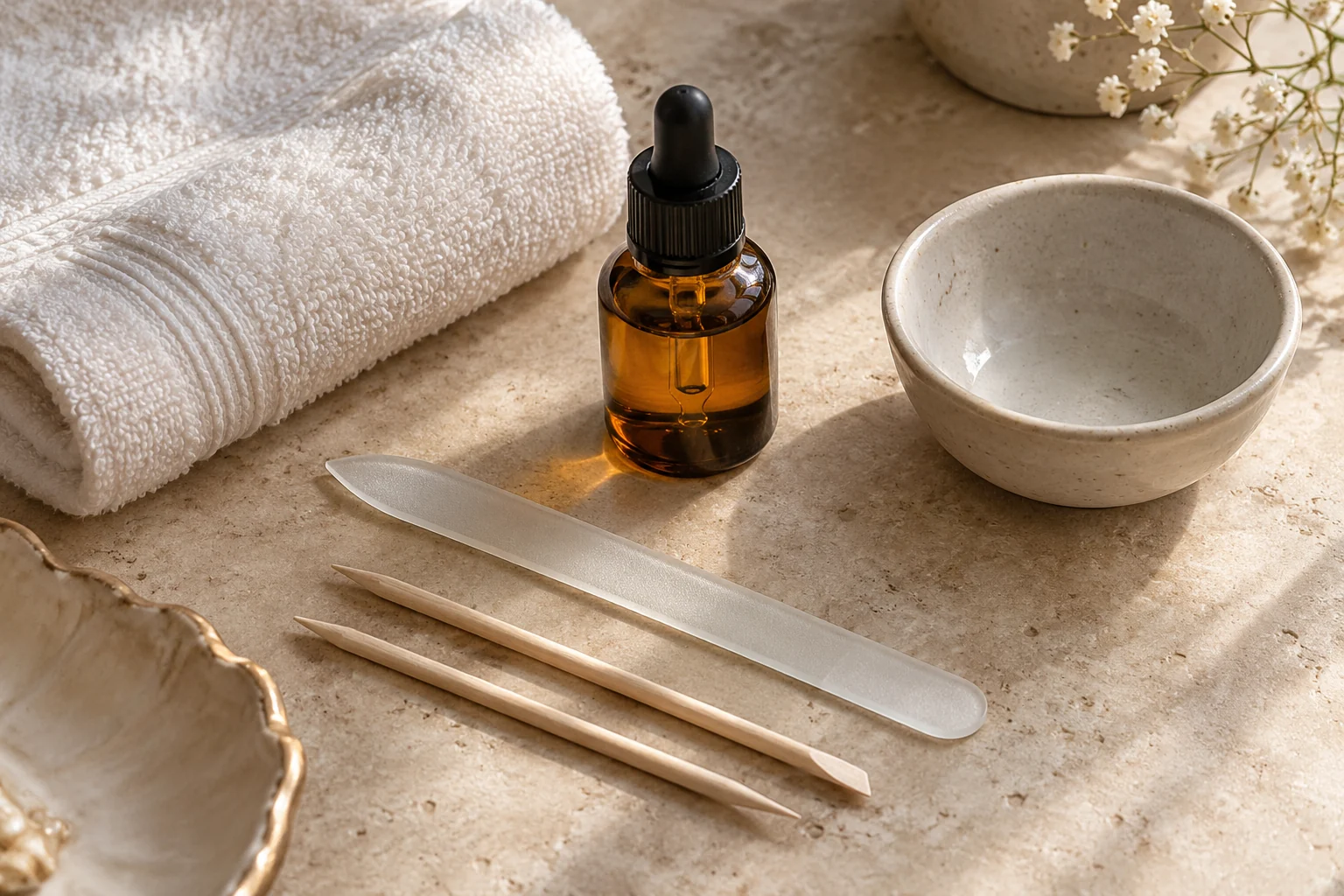
The first-use cost of strips may include a compatible lamp and removal supplies. A press-on purchase may include adhesive, but you still need to check what is actually in the box and what is required for removal. Shipping and unused accessories can change the comparison.
For illustration, suppose one complete route costs twenty dollars initially and another costs thirty-five because it includes reusable equipment. That does not establish which is cheaper over time. You would also need to know the cost of later sets, how many usable applications each provides, and whether you actually continue using the equipment.
Do not count every piece as a usable nail or assume every leftover strip creates another full manicure. Size distribution matters. Likewise, do not assume finished nails can be reused unless the specific product supports that use. A realistic calculation is based on your usable sets and actual routine, not the most optimistic interpretation of the package count.
Four common shopping scenarios
If you want a long French manicure for an occasion and your natural nails are short, begin with finished press-ons in the desired shape. The main checks are fit, length, adhesive instructions, and removal. A strip with a similar color would not provide the same change in outline.
If you want burgundy color on nails whose length already suits you, a semi-cured strip could be the more relevant format, provided you want its curing routine. If you want a short finished set without handling a separate glue bottle, examine a product with pre-applied adhesive. If you want frequent changes, compare the complete removal requirements before choosing any of these routes.
These scenarios are not rankings. They show how the same product can be suitable for one goal and unnecessary for another. Once the format is right, compare the specific items within it. That is where brand, shade, sizes, and seller information become useful rather than distracting.
A practical first-purchase plan
Buy one clearly identified set instead of several speculative variants. Read the directions before the day you intend to use it, check the contents, and arrange the required equipment. Make sure the product is the format you intended: a flexible strip, a finished glue-on nail, or a pre-applied-adhesive set.
Evaluate one main question on the first attempt. You might be testing whether you like added length or whether you enjoy applying strips. Trying several new accessories and altering the manufacturer’s method at the same time makes the experience harder to interpret.
Keep notes that will improve the next purchase: preferred sizes, chosen length, useful tools, and anything you found awkward. If the category suits you, explore another design. If it does not, use that information to change formats rather than buying a larger bundle of the same mismatch. More products are not necessarily more choice when the underlying routine is wrong for you.
Products to consider by use case
For a long French extension: KISS Every Minute
This long square glue-on design is relevant when the shape and added length are central to your goal. Check the selected variant and supplied sizes before buying additional packs. It represents the finished-extension route rather than a strip application. View Every Minute on Amazon
For a long pearly look: OPI Throw Me a Kiss
Choose the Long Coffin xPRESS/ON version if a tapered outline and pale iridescent effect suit your styling brief. It is an alternative aesthetic within finished press-ons, not evidence that one brand has better wear. View Throw Me a Kiss on Amazon
For color at your natural length: ohora N Classic Burgundy
The official shade listing provides a concrete option for the semi-cured route. It is worth comparing if you want a deep wine-red color and already understand the compatible lamp and removal requirements. View N Classic Burgundy on Amazon
For a short pre-applied-adhesive option: imPRESS Point Pink
This short squoval style is a candidate for someone who prefers a ready-made set without dispensing separate nail glue. Follow its own instructions rather than borrowing the glue-on routine from another kit. Shop Point Pink on Amazon
Product specifications can change. Confirm the selected variant and current manufacturer instructions before purchase. Source links are included beside the relevant claims.
1 thought on “Press-On Nails vs Semi-Cured Gel Strips: Buying Guide”
Comments are closed.