THE CUREMANI EDIT / BUYING GUIDE
Nail Glue vs Adhesive Tabs for Press-On Nails
Choose a complete attachment routine, from fit to removal.
As an Amazon Associate I earn from qualifying purchases. Some links below are affiliate links; official brand links are labeled separately. About our links.
Editorial research review · Sources checked October 16, 2026 · No hands-on wear test or independent performance score.
Nail glue and adhesive tabs offer different ways to attach finished press-on nails. The right choice depends on the specific set, its instructions, your preferred application process, and how you intend to remove it. A useful comparison begins with compatibility rather than a promise that one method is always stronger, gentler, or easier.
This guide compares documented formats and practical buying questions. It is not a controlled adhesion test, and we have not measured wear time or removal force. We do not rank the methods by an invented strength score. The aim is to help you choose a complete, understandable routine and recognize when a product is not the right match.
| Format | Main buying question |
|---|---|
| Separate nail glue | Does the nail kit specify this adhesive? |
| Factory-applied adhesive | Can you follow the supplied peel-and-press routine? |
| Loose adhesive tabs | Are the tabs supported for the chosen nails? |
| Lamp-cured attachment | Does this require a different system and compatible equipment? |
In this guide · 13 sections
- Understand the three formats before comparing them
- Why compatibility comes before preference
- Application: handling a liquid versus positioning a layer
- Fit is not an adhesive problem to solve
- Decide what kind of commitment you want
- Wear claims need more context than a day count
- Removal is where the systems must stay separate
- Reuse: read the product claim, not the social caption
- Daily activities: use specifics instead of stereotypes
- How to interpret early problems
- Compare the whole cost
- A useful decision sequence for beginners
- Products to consider
Understand the three formats before comparing them
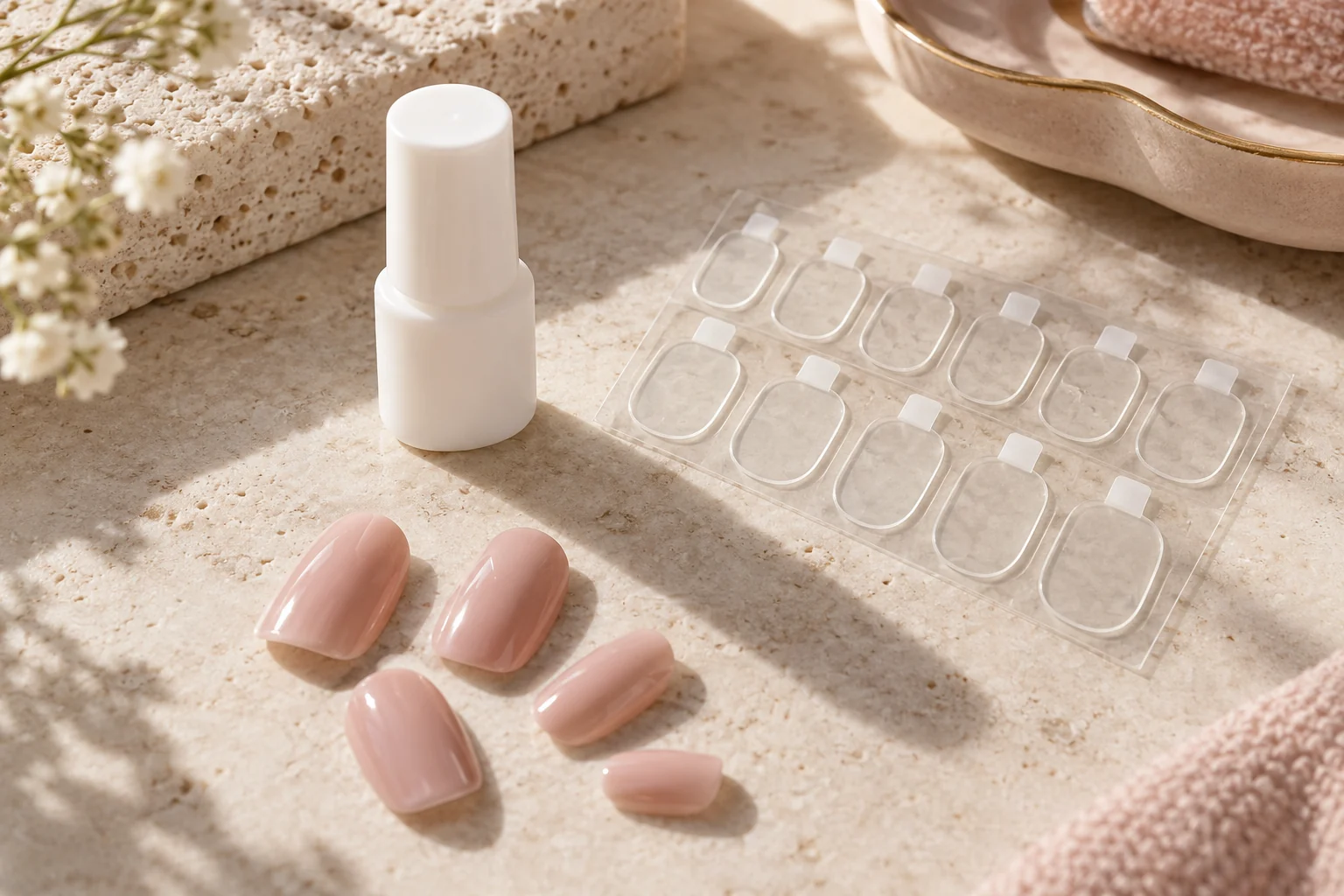
Conventional nail glue is a separate product used according to the nail kit’s directions. You need to handle and dispense it as instructed. A set with pre-applied adhesive arrives with the attachment layer already on the nail, so the ordinary application process does not involve adding a separate bottle of glue.
Loose adhesive tabs are separate pieces selected and positioned as part of a compatible system. Their size, placement, and removal instructions still matter. They should not be assumed to be equivalent to the factory-applied adhesive on every ready-made set simply because both are sticky layers.
There is a fourth category worth keeping separate: lamp-cured gel attachment systems. A product labeled gel glue may require equipment and directions that differ from conventional nail glue. Read the label rather than deciding by texture, packaging, or the word gel alone. This article concerns ordinary finished press-on choices, not a universal method for every nail extension system.
Why compatibility comes before preference
You might prefer the idea of tabs because you want an uncomplicated process, or prefer glue because that is what you have used before. Those preferences are reasonable starting points, but they do not override the directions for the product you buy.
A finished nail may have a factory-applied adhesive layer that is part of its design. Adding another adhesive can change the intended routine. Similarly, a set marketed for a specific glue-on application should not automatically be treated as a reusable tab set. Look for explicit compatibility rather than assuming all full-cover pieces are interchangeable.
If the maker does not explain a proposed substitution, the practical answer is to choose a product designed around the method you want. That is often simpler than trying to convert an unsuitable kit. The saved effort is not just at application; it also makes the removal instructions more clearly applicable.
Application: handling a liquid versus positioning a layer
With separate glue, the routine includes handling the container and placing the adhesive as directed. That may feel familiar to an experienced user, but it adds a task for someone who is new to press-ons. A clear workspace and readable instructions are more useful than trying to reproduce a very fast demonstration.
With a pre-applied system, the attachment layer is already present. The imPRESS Point Pink instructions describe a peel-and-press process and give their own timing and removal directions. That reduces one handling step, but it does not remove the need to select sizes or prepare appropriately.
Separate tabs add a positioning decision of their own. You need to follow the instructions for both the tabs and the compatible nails. Calling a method easy should therefore mean that you understand and can follow its steps, not that it has no steps or that everyone will find it equally straightforward.
Fit is not an adhesive problem to solve
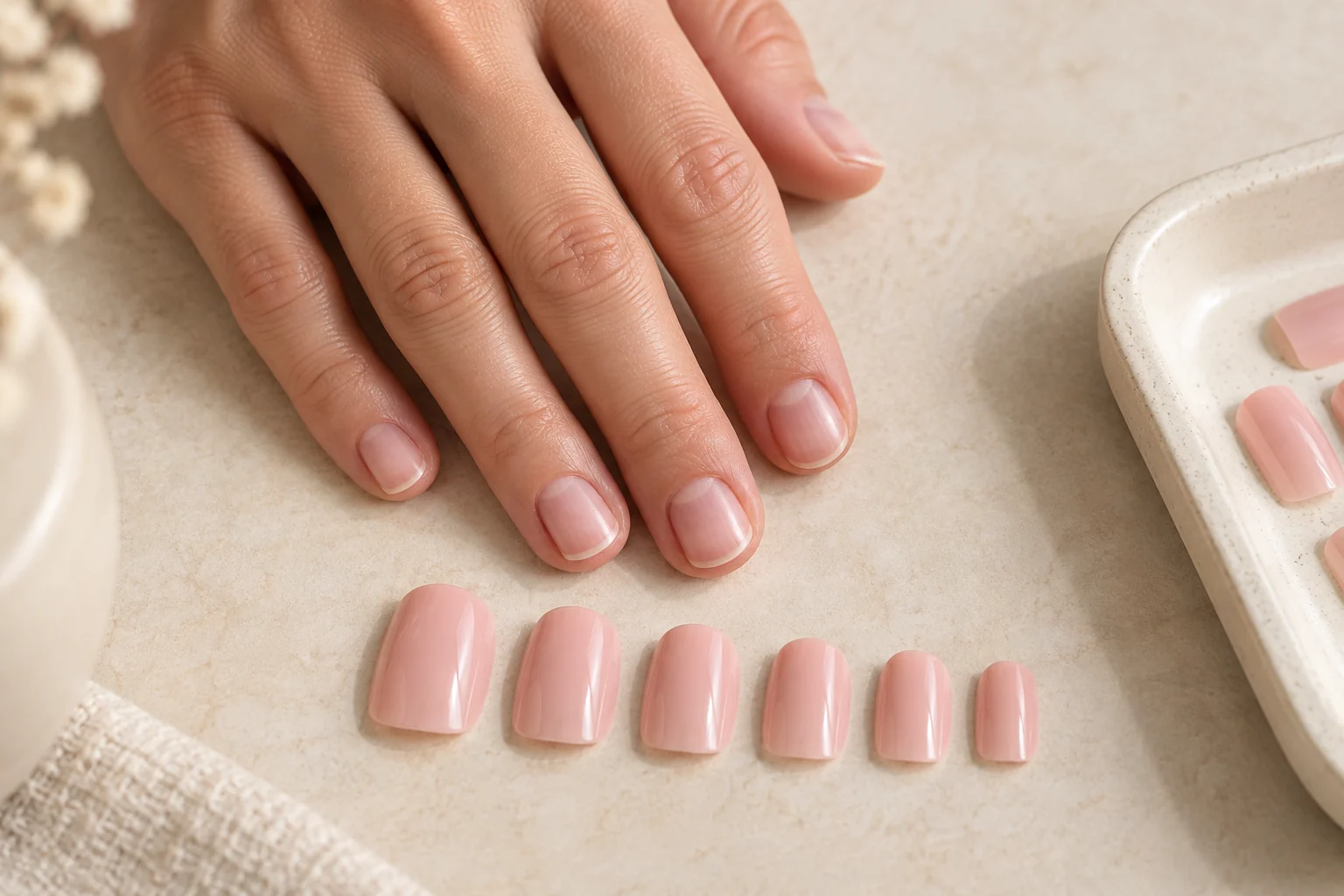
An ill-fitting nail can make any attachment method difficult to evaluate. Width, curve, and the cuticle outline should be checked before deciding that you need a stronger product. If a piece does not sit comfortably during sizing, adding more adhesive is not a reliable way to make its shape appropriate.
This is especially important when comparing methods from customer comments. A person may report that a set came away, but without information about fit, preparation, and the specific product, the cause is uncertain. That comment can be a useful prompt to investigate, but it is not enough to establish that an entire adhesive category fails.
During your own selection process, identify a complete set of suitable sizes first. Keep the attachment decision separate from the decorative shape. If a particular brand’s pieces do not fit, a different size range or construction may matter more than choosing between glue and tabs.
Decide what kind of commitment you want
Some shoppers want a manicure for one event, while others want to avoid changing their nails frequently. That difference should influence which complete product routine they investigate. However, a short intended wear period does not automatically mean any adhesive can be removed immediately or without the specified supplies.
Read removal directions before buying, particularly if you have a fixed time when the nails must come off. Workplace requirements, sports, and other commitments can make that deadline important. Do not assume a product advertised as convenient will match your schedule without checking what the maker says.
Likewise, wanting longer wear does not justify ignoring discomfort or trying unsupported combinations. The goal is a suitable manicure, not an endurance record. Product choice should account for how you will stop using it as carefully as how you will put it on.
Wear claims need more context than a day count
A stated maximum duration is not the same as a guaranteed result. Fit, application, activities, and the particular product all affect how informative that number is. Two people reporting different outcomes may both be describing their experiences accurately.
For a useful comparison, look for accounts that identify the exact set and attachment method. A review of a pre-applied-adhesive product does not establish how loose tabs would perform with another nail. A successful glue-on manicure also cannot prove that adding the same glue to a different system is appropriate.
We have not conducted a controlled comparison, so this guide makes no blanket claim that glue lasts a fixed number of days longer than tabs. If longevity is your deciding factor, assess detailed evidence for the actual product and keep the manufacturer’s limits and removal directions in view.
Removal is where the systems must stay separate
The KISS glue-on FAQ describes removal for that attachment type and warns against forcing the nails off. A pre-applied-adhesive set can specify a different approach. Follow the directions for what is actually on your nails rather than borrowing the easiest-sounding step from another method.
Before application, identify the appropriate removal supplies and where you will keep them. That is a practical preparation task, not an optional upgrade. If you do not have the needed supplies, delaying application is more sensible than relying on a future delivery or a guess about what will work.
Do not make preserving the decorative piece the overriding goal. If a removal process makes a nail unsuitable for reuse, that is different from having a reusable system. A cost-saving plan should not encourage forceful removal or an unsupported technique just to keep an attractive design intact.
Reuse: read the product claim, not the social caption
Reusable is a property that needs to be established for the specific product and method. A photograph of nails stored in a box does not show how they were removed or whether they remain suitable to apply again. Neither a glossy finish nor a high purchase price proves repeat-use suitability.
KISS’s FAQ distinguishes its general single-use products from a named reusable line. That is a good reminder to check rather than extrapolate. Other products may have different policies and instructions. Read the current guidance for the item you are considering, including any limits associated with the attachment method.
When calculating value, separate a verified reusable routine from an optimistic possibility. A set that could perhaps be worn again should not automatically be assigned three or four uses in a budget. Start with what the instructions support and revise your own cost record only after an appropriate use actually occurs.
Daily activities: use specifics instead of stereotypes
Consider the tasks your manicure will encounter: repeated handwashing, food preparation, gloves, household work, or handling small objects. This list helps you compare a product’s directions with your routine. It does not support a universal claim that one adhesive method is right for every person with the same job.
Read any waiting periods and care instructions that apply after application. Plan around them rather than deciding after the manicure that the directions are inconvenient. If a product’s requirements conflict with an obligation you cannot change, choose another time or another format.
Keep length in the comparison as well. A short pre-applied set and a long glue-on set differ in more than adhesive. If one feels more practical, the length may be a major reason. A fair assessment avoids crediting or blaming the attachment method for every difference in the overall experience.
How to interpret early problems
If something does not work as expected, record what happened rather than immediately adding another product. Was the piece unsuitable during sizing? Did an edge lift? Was there discomfort? Did a specific impact occur? These details help separate fit, application, and daily-use questions.
Follow the manufacturer’s guidance for dealing with a compromised nail. Avoid repeatedly layering adhesives as an improvised fix, particularly when the original system is unclear. Starting again with the correct routine may be more appropriate than building an increasingly complicated attachment.
Persistent irritation, pain, or a visible nail problem is a reason to stop cosmetic experimentation and seek appropriate advice. The American Academy of Dermatology discusses precautions around artificial nails. This guide does not identify an adhesive as universally safe or offer a home test that can rule out sensitivity.
Compare the whole cost
A separate bottle of glue may serve more than one application when used and stored as directed, but that does not make every glue-on route cheaper. You still need suitable nails, removal supplies, and a realistic understanding of what remains usable after opening.
A pre-applied set packages part of the routine together, which can simplify the shopping list. Loose tabs may be a separate purchase. Compare the actual contents and compatible supplies rather than counting only the decorative nails or choosing the lowest advertised price per piece.
An illustrative first-use budget might include a twelve-dollar set and six dollars of missing removal supplies. Another seventeen-dollar purchase could include more of what you need. Neither example represents a live price or proves which method is better value. Write down the full basket for the products you are actually considering and compare those totals.
A useful decision sequence for beginners
First choose the finished nail length and design you want. Next identify the product’s intended attachment system. Then read application and removal directions together. Finally, check whether you have the supplies, time, and confidence to follow that routine without substitutions.
If you dislike handling a separate glue bottle, a clearly labeled pre-applied product is a sensible category to explore. If you are comfortable with conventional glue-on instructions and want a design available in that format, consider that route. If you want loose tabs, choose a combination whose maker explicitly supports them.
Do not buy several new systems for the first attempt. A single clear routine makes it easier to understand what you like and what you want to change. Our CureMani Shop can help you compare styles, but the package directions remain the authority for application and removal.
Products to consider
KISS imPRESS Point Pink: pre-applied adhesive
This short squoval pink set is a relevant starting point if you prefer not to dispense separate glue. It is not presented here as a loose-tab product; the adhesive comes on the nails. Check the current instructions and choose it for that defined format. Shop Point Pink on Amazon
KISS Core French Every Minute: a conventional glue-on option
Consider this long square French set if you want the structured design and are comfortable following its glue-on routine. Its length is an independent decision from the adhesive, so do not select it solely because you prefer glue. View the selected Every Minute listing on Amazon
OPI xPRESS/ON Throw Me a Kiss: a different glue-on style
The Long Coffin version provides a pale iridescent alternative for someone choosing a finished extension. Compare it for shape and finish, then follow OPI’s own application and removal guidance. We have not established that its attachment performs better than the other options. View the selected OPI listing on Amazon
Product specifications can change. Confirm the selected variant and current manufacturer instructions before purchase. Source links are included beside the relevant claims.
2 thoughts on “Nail Glue vs Adhesive Tabs for Press-On Nails”
Comments are closed.